
Table of Contents
Table of Contents
Chemical reactions and equations is the first chapter of CBSE Class 10 Science. Practise 15 chemical reactions and equations PYQs below, check the answers and read the explanation for every question. Then use the quick notes, tips and FAQs on this page to revise faster.
📖 Class 10 Science Previous Year Questions (PYQs)
📝 Chapter-wise & Mixed Board Exam Questions
Below are previous year board exam questions for Class 10 Science (Physics, Chemistry, Biology). Each question includes 4 options. Click the button to see the correct answer + concept explanation.
During the electrolysis of water, water decomposes to form hydrogen and oxygen gases: The volume ratio of hydrogen to oxygen is 2 : 1, but since oxygen is eight times heavier than hydrogen, the mass ratio (Mₕ : Mₒ) is 1 : 8.
- Dilute hydrochloric acid reacts with sodium hydroxide
- Magnesium oxide reacts with dilute hydrochloric acid
- Carbon dioxide reacts with sodium hydroxide
In all three reactions, an acid reacts with a base (or basic oxide) to produce salt and water, which is a neutralisation reaction — a type of double displacement reaction.
Melting of glaciers is only a physical change — the state of water changes from solid (ice) to liquid, but no new substance is formed. Hence, no chemical reaction takes place.
When natural gas (methane) burns in air, it combines with oxygen to form carbon dioxide and water, releasing heat energy. This makes it an exothermic reaction.
pAl + qH₂O → rAl₂O₃ + sH₂
To balance this equation, the values of ‘p‘, ‘q‘, ‘r‘, and ‘s‘ are:
Write skeletal equation: Al + H₂O → Al₂O₃ + H₂ Balance Al → 2Al + H₂O → Al₂O₃ + H₂ Balance O → 3H₂O → Al₂O₃ + H₂ Balance H → 3H₂O → Al₂O₃ + 3H₂ Final: 2Al + 3H₂O → Al₂O₃ + 3H₂
- Magnesium ribbon burns with a dazzling white flame
- A white powder is formed
- Magnesium ribbon vaporises
- Aqueous solution of the white powder turns blue litmus red
When magnesium ribbon burns in air, it burns with a dazzling white flame and forms a white powder of magnesium oxide, showing that a chemical reaction has taken place.
aPb(NO₃)₂ → bPbO + cNO₂ + dO₂
Balancing Steps (1 Mark):
- Write skeletal equation: Pb(NO₃)₂ → PbO + NO₂ + O₂.
- Balance Pb: 1 atom on each side → no change.
- Balance N: There are 2 nitrogen atoms in Pb(NO₃)₂, so write 2Pb(NO₃)₂ → 2PbO + 4NO₂ + O₂.
- Balance O: Left side has 12 oxygen atoms; right side has 2 (in PbO) + 8 (in NO₂) + 2 in O2 = 12 → balanced.
Thermal decomposition reactions are those that require heat to break down a compound into simpler substances. CaCO₃ → CaO + CO₂ (by heating) 2KClO₃ → 2KCl + 3O₂ (by heating) Both are thermal decomposition reactions.
A: Decomposition reactions usually require energy (heat, light, or electricity), making them endothermic. R: Composting involves microbial breakdown, releasing heat (exothermic). Both are true, but R describes an exception (biological process), not a general explanation for A.
When silver chloride is exposed to sunlight, it decomposes into silver and chlorine gas, turning the substance grey due to the formation of silver metal.
All exothermic reactions release heat, but not necessarily light. Also, combination reactions may or may not be exothermic — for example, formation of slaked lime is exothermic, but not all combination reactions release light.
Chemical Reactions and Equations: Key Concepts
A chemical reaction changes one or more substances into new substances with different properties. A chemical equation is a short way to write a chemical reaction using symbols and formulae. In every chemical reactions and equations question, first check whether the equation is balanced and then identify the type of reaction. Board exam questions on chemical reactions and equations usually test balancing, types of reactions and observations.
You can recognise a chemical reaction by one or more of these changes:
- change in state
- change in colour
- evolution of a gas
- change in temperature
- formation of a precipitate
Types of Chemical Reactions with Examples
CBSE Class 10 Science groups chemical reactions into the types below. Learn at least one example of each type.
| Type of reaction | What happens | Example |
|---|---|---|
| Combination reaction | Two or more reactants combine to form a single product | CaO + H2O → Ca(OH)2 |
| Decomposition reaction | A single reactant breaks down into two or more products | CaCO3 → CaO + CO2 (on heating) |
| Displacement reaction | A more reactive element displaces a less reactive element from its compound | Fe + CuSO4 → FeSO4 + Cu |
| Double displacement reaction | Two compounds exchange ions to form two new compounds | Na2SO4 + BaCl2 → BaSO4 + 2NaCl |
| Oxidation-reduction (redox) reaction | Oxidation and reduction take place together in the same reaction | CuO + H2 → Cu + H2O |
Reactions that release heat are called exothermic reactions, and reactions that absorb heat are called endothermic reactions. Rusting of iron and rancidity of fats and oils are everyday examples of oxidation.
How to Balance Chemical Equations Step by Step
- Write the skeletal equation using the correct formulae of all reactants and products.
- Count the atoms of each element on the left and right sides.
- Balance one element at a time by writing coefficients in front of formulae. Never change the subscripts.
- Balance hydrogen and oxygen atoms at the end.
- Add the physical states (s), (l), (g) and (aq), and write the reaction conditions if they are given.
- Count the atoms again to confirm that the equation is balanced.
Example: Fe + H2O → Fe3O4 + H2 becomes 3Fe + 4H2O → Fe3O4 + 4H2 after balancing. For more practice, read our balancing chemical equations guide.
Tips to Solve Chemical Reactions and Equations MCQs
Solving chemical reactions and equations PYQs shows you the board exam pattern, helps you find weak topics and improves your speed. Regular practice of chemical reactions and equations MCQs also builds confidence for the full Class 10 Science paper.
- Read the full question and all four options before you choose an answer.
- Check that the number of atoms of each element is equal on both sides before you pick a balanced equation.
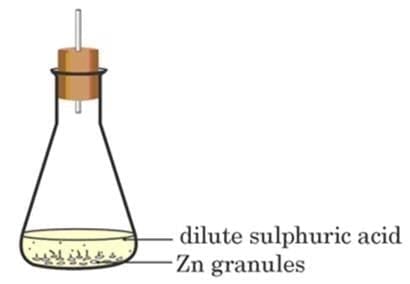
- Remember common observations, for example zinc granules with dilute sulphuric acid give bubbles of hydrogen gas.
- Oxidation is the gain of oxygen or loss of hydrogen. Reduction is the loss of oxygen or gain of hydrogen.
- Practise previous year questions regularly and solve them on a timer.
Common Mistakes in Chemical Reactions and Equations
- Changing the subscripts of a formula instead of the coefficients while balancing.
- Forgetting to recount the atoms after adding a coefficient.
- Mixing up oxidation and reduction.
- Writing wrong formulae for reactants or products.
- Ignoring physical states and reaction conditions.
More Class 10 Study Material
- NCERT Science textbooks (PDF)
- CBSE Class 10 sample papers
- NCERT Chemistry guide to acids, bases and salts
- Official NCERT textbooks are also available on the NCERT website.
- Check the latest syllabus and notices on the CBSE Academic website.
FAQs on Chemical Reactions and Equations PYQs
Which chapter is chemical reactions and equations in Class 10 Science?
It is Chapter 1 of the CBSE Class 10 Science textbook.
How many PYQs are given on this page?
This page has 15 previous year board exam MCQs on chemical reactions and equations, each with the correct answer and an explanation.
How should I revise chemical reactions and equations?
Learn the five types of reactions with one example each, practise balancing equations, and then solve PYQs on a timer.
Keep practising these chemical reactions and equations PYQs along with the NCERT chapter, and revise the types of reactions before the exam.
yeh website badi nigger and untouchable hai
my website is better than ts, but my website lowky has virus and trackers to hack users's info
Hello niggesh contact with me on my personal number 6396972342
Hello niggesh contact with me on my personal number 6396972342